


Andriana and Roman Matys spoke to the Ukrainian magazine Fokus about My Ethno (Ukrainian: «Моє Етно»), a cultural project that gives Ukrainians back the knowledge of their own rituals, songs, food and holidays. The first edition, “My Ethno – Boykivshchyna”, takes place on 12 December 2026 in Lviv, at the BARVY venue.
What My Ethno is
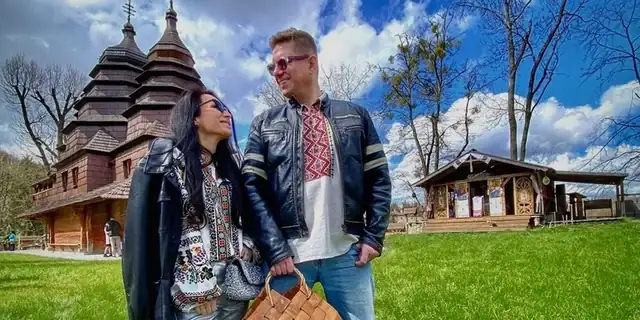
The project was founded by Andriana Matys, an artist and co-founder of Vyshyvanka YOLANTA. She is reviving the tradition of embroidering one’s own shirt, which she sees as an important cultural and therapeutic practice. Roman Matys develops My Ethno together with her. Each edition is an evening gathering where conversations, music, rituals and food come together into a single performance.
“We have all of this, but it lives separately,” Andriana explains. Songs sit in archives, recipes are kept in families, and the rituals are remembered by older people in villages. My Ethno brings it all into one place for one evening.
Ten years, two holidays, one region
The series is planned for ten years. Twice a year, before Christmas and before Easter, the organisers choose one ethnic region and dedicate two editions to it, one for Christmas and one for Easter. Over ten years the project will cover Ukraine from Boykivshchyna in the west to Slobozhanshchyna in the east. All gatherings take place in Lviv.
Why these two holidays? Christmas and Easter are the main points of the yearly cycle. Their rituals survived centuries of bans better than anything else because families and the church kept them alive.
The first edition: Boykivshchyna
Boykivshchyna, the land of the Boyko highlanders, covers parts of the Lviv, Ivano-Frankivsk and Zakarpattia regions. Folklore that has disappeared everywhere else still lives there.
On 12 December, guests at BARVY will see a nativity play (vertep) from the village of Lybokhora that has never been staged before. It is performed by children and teenagers using texts passed down to them by older villagers. There will be the premiere of an old Boyko dance that almost nobody has seen, a concert by the band Kurbasy and a shared carol. The table will hold Boyko food: mushrooms, beans, potatoes, cabbage and good bread.
“I want people to taste, ask questions and remember how this dish was made in their own family,” says Andriana Matys.
Recordings of the event will be submitted to Ukraine’s national register of intangible cultural heritage.
Why this is about memory
The Boykos lived through several forced deportations. In 1951 the USSR and Poland exchanged sections of their border, and whole villages of the Ustrzyki area were moved to Donbas and the southern steppes. Their descendants now live in Donbas and the Kherson and Mykolaiv regions, and many of them no longer know where their families came from.
Ukrainian folklore was suppressed for centuries. The Valuev Circular of 1863 and the Ems Decree of 1876 banned Ukrainian texts, including lyrics printed under sheet music, so many songs were never written down. Soviet authorities declared Christmas a relic of the past, broke up nativity plays and replaced Christmas Eve with the New Year tree.
Roman Matys, initiator and co-author of Ukraine’s law on the Ukrainian language, sees a direct link: “Language is the road by which culture reaches a person.” And he adds: “You can’t sing a carol in translation – it falls apart.”
Identity as capital
Roman Matys explains his motivation in terms familiar to an economist: “Identity works like capital that you can’t borrow. Either generations have accumulated it, or it isn’t there.”
Andriana Matys points to time: the people who carry these traditions are getting older, and there is no room for delay. “If we leave this for ‘after the victory’, we may find there is not much left to defend,” she says. The war has not made the carol less important: at Christmas, soldiers sing carols in their dugouts, and the whole country watches the videos.
The couple’s goal is simple: that after the evening, guests ask their parents and grandparents how Christmas was celebrated in their family. “If even some of the guests do that, we will bring back something that was methodically taken from us for a hundred years,” says Roman Matys.
How to attend “My Ethno – Boykivshchyna”
The event takes place on 12 December 2026 from 14:00 to 21:50 at the BARVY venue in Lviv. Tickets are available at moyeethno.events; places are limited.
Andriana Matys is an artist, founder of My Ethno and co-founder of Vyshyvanka YOLANTA, and is reviving the tradition of embroidering one’s own shirt. Roman Matys is President of the International Investment Office, founder of the International Economic Forum and Lviv Summer Jazz Fest.
Frequently asked questions
A cultural project by Andriana and Roman Matys: evening gatherings in Lviv devoted to the rituals, songs, food and holidays of one ethnic region of Ukraine. The series is planned for ten years.
On 12 December 2026, from 14:00 to 21:50, at the BARVY venue in Lviv. Tickets at moyeethno.events.
A nativity play from the village of Lybokhora never staged before, the premiere of an old Boyko dance, a concert by Kurbasy, a shared carol and traditional Boyko food.
Boykivshchyna has preserved folklore that has disappeared elsewhere, and the history of the Boykos’ forced deportations makes saving their traditions especially urgent.