


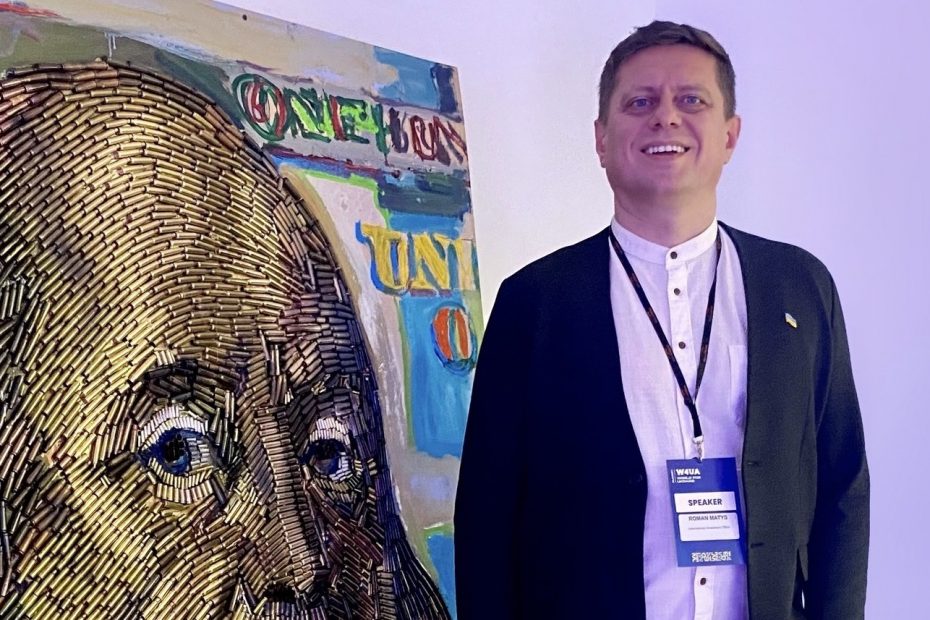
“When will be the best time to invest in Ukraine?” Roman Matys hears this question at every international economic event. His answer: in some sectors it may already be a little late to think about taking a leading position. Below are examples that prove the point.

Over the past few months I have taken part in six economic events abroad, as a moderator or panel speaker on the prospects of Ukraine’s economy, its reconstruction and investment in Ukraine.
Each time the audience fell into three main groups:
- those who understand the opportunities opening up in Ukraine today and need to refine their own forecasts before deciding to enter the Ukrainian market;
- those who understand these opportunities but fear the war, looking for confirmation of their fears and telling themselves: “I will be first in as soon as the war ends”;
- those who understand these opportunities and are already investing or actively preparing to invest.
There were, of course, sceptics about investing in Ukraine, but so few that they stay within the margin of error.
Understanding the opportunities does not remove the need for dialogue on creating conditions that stimulate investment in Ukraine: war-risk insurance, special and more competitive conditions and rules for doing business in Ukraine, and so on. These dialogues are already under way or will be launched with the help of lobbying tools. That is why those who do not want to miss their chance are starting work now — at least the organisational and preparatory work, which also takes time.
“Ukraine is the new China”
My slogan “Ukraine is the new China”, which I first voiced in June 2018 at the World Manufacturing Convention in China, carries even more weight given China’s behaviour in the context of the war in Ukraine. For European markets the benefits of relocating production from China closer to end markets are becoming ever more obvious. It is not only a shorter supply chain and lower delivery costs in the product price, but also certain security guarantees in the longer term, when global business has to take a geopolitical position because of China’s conduct.
Whether that is support given to russia or an attempt to seize part of it matters less. The choice “stay in the Chinese market or leave?” will have to be made. Building new production closer to end markets will not mean closing plants in China — they will remain to serve Asian markets. And we must do everything to ensure that production for European markets is launched in Ukraine.
“Lviv Region — the Factory of Europe” will be joined by Ternopil, Khmelnytskyi, Ivano-Frankivsk, Rivne, Vinnytsia, Volyn, Zakarpattia, Bukovyna and other regions, each with its own specialisation. Events in the country’s economic life confirm that I am not fantasising.
Energy: small modular reactors and new power units
For example, let me return to the outlook for Ukraine’s energy market that I published on 27 January. I wrote then that Japan plans to take part in rebuilding Ukraine’s energy sector on the basis of the latest technologies, in particular building small modular reactors and jointly implementing hydrogen projects, where Japan has perhaps the best expertise. Back in 2019, ISCN — Japan Atomic Energy Agency (JAEA), under a memorandum between Japan and the United Kingdom on cooperation on a high-temperature gas-cooled reactor, announced intensified cooperation.
At the same time, the UK allocated £18 million to Rolls-Royce to start designing a modular system, and Rolls-Royce announced a plan to build 16 small modular reactors, the first to be launched by 2030. And on 20 March 2023 NNEGC Energoatom and the British company Rolls-Royce SMR signed a Memorandum of Understanding on Ukraine’s recovery through the deployment of small modular reactors (SMR).
Under the Memorandum, Rolls-Royce SMR undertakes to support Ukraine’s recovery by deploying a power plant with a factory-built small modular reactor (SMR), able to generate enough zero-carbon electricity to power a million homes for more than 60 years.
The document was signed by Energoatom President Petro Kotin and, for Rolls-Royce SMR, by Sophie Macfarlane-Smith, Head of Customer Engagement. What is this, if not proof that Ukraine’s prospects are understood, and active preparation for a modern, safe and green project to diversify the energy system?
Continuing the theme: an international consortium of the US Argonne National Laboratory, Energoatom and the State Scientific and Technical Center for Nuclear and Radiation Safety (with the National Security and Defense Council and, in future, private investors) has started work on a USD 1 billion pilot project to build a small modular reactor. This was officially announced by US Special Presidential Envoy for Climate John Kerry and Ukraine’s Minister of Energy. With US support, “Project Phoenix” will also be created in Ukraine to accelerate the conversion of coal power plants in Central and Eastern Europe to small modular reactors.
By 2030–2032, two AP1000® units based on Westinghouse’s American technology are planned to be completed at the Khmelnytskyi NPP for Energoatom, with a total budget of about USD 10 billion; nine such units are planned in all. There is even talk of reviving the nuclear power plant project in Cherkasy Region near Chyhyryn, first planned back in 1988.
Energoatom also plans a national network of 120 electric vehicle charging stations: 40 high-power (160+ kW) and 80 medium-power (60+ kW). And that is not all the investment in Ukrainian energy. Despite the war, DTEK continues to build a 100 MW wind farm in southern Ukraine, investing almost USD 100 million. Gaztranzit plans to start building a bioethanol plant in Odesa Region worth EUR 30–35 million at the end of 2023, followed by three more in different regions, including Lviv Region.
New factories in other sectors
HEAD Group Sports has resumed its investment in Ukraine and continues building its plant in the Vinnytsia industrial park: EUR 80 million, 43,000 m² of production space (now including a shelter) and 1,200 jobs. British American Tobacco Ukraine invested USD 41 million in a new workshop at its factory in Pryluky and moved production of one product line fully to Ukraine. Magellan Investment Holdings plans to invest EUR 250 million in a glass factory in Kirovohrad Region. And let us not forget the Baykar drone plant.
There are many more smaller but no less important projects. They cover every sector of the economy, and I often use them to answer the question “When will be the best time to invest in Ukraine?”: in some sectors it may already be a little late to think about leadership.
Let me repeat: we still have a lot of “homework” to do — first of all, to destroy russia as a strong geopolitical player. But these are parallel, not sequential processes. Whoever invests in Ukraine now not only gains, but also invests in Ukraine’s victory.
P.S. For those who like to talk about corruption as a factor holding back investment in Ukraine, here is a recent film by The Economist on how Belgium became the hub of cocaine trafficking in Europe, on corruption among European politicians, Belgian customs officers and so on 😉